If you're choosing a ring fitness tracker as one of the best wearables for yoga, you're probably less interested in VO₂-max flexing and more in calm: smoother breath, deeper stretches, and fewer distractions on the mat. The challenge is that most rings are marketed for sleep and recovery, not clearly for yoga poses or breathwork, and almost nobody explains how that actually plays out day to day (especially once subscriptions, exports, and privacy enter the picture).
This FAQ-style deep dive walks through what ring trackers can and can't do for yoga, how accurate breath work tracking really is, and which options make sense once you factor in lifetime cost and data control.
Renting data is still paying.
Why choose a ring fitness tracker over a watch for yoga and breathwork?
Practical differences when you're on the mat:
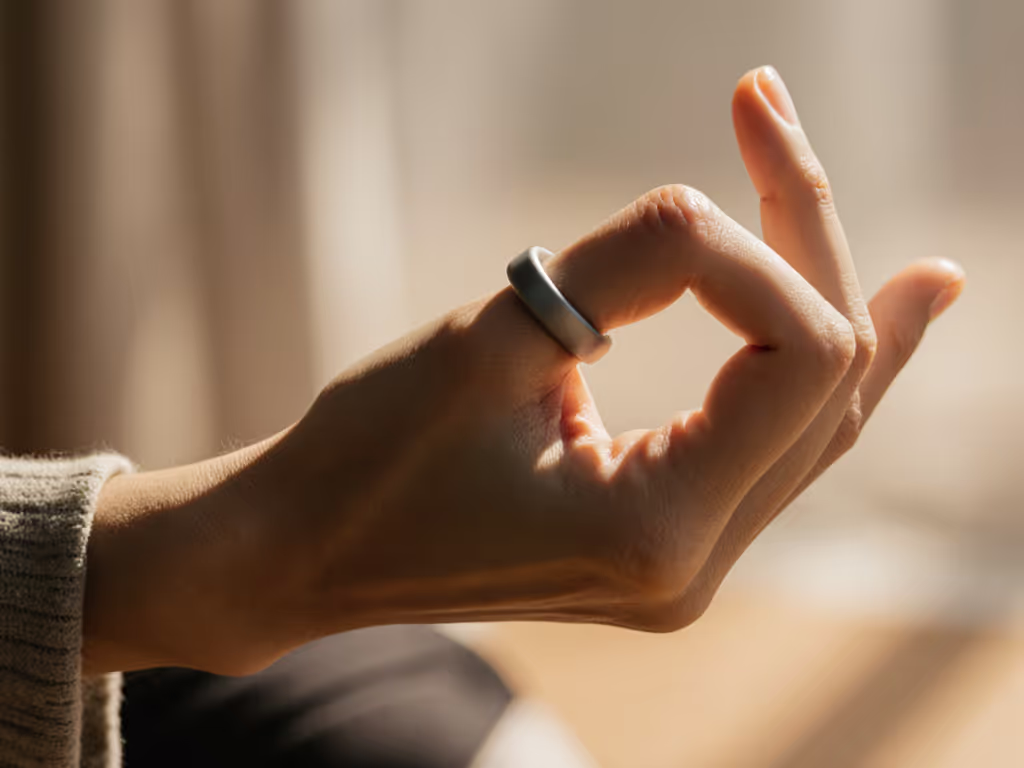
Less interference with poses: In downward dog, planks, or arm balances, wrist bands push into your skin, shift sensors, and can misread your heart rate. A well-fitted ring usually stays put and is out of the way.
Sleep and restoration bias: Most smart rings are built around sleep, HRV, and recovery. If your yoga practice leans toward restorative, yin, or breathwork, that bias works in your favor.
Distraction-free: Rings have no or minimal displays. That's a feature during meditation (less temptation to check notifications).
But there are trade-offs:
No GPS, limited on-device controls: Rings won't replace a running watch. You're trading buttons and screens for simplicity.
Haptics and cues are less robust: Most rings don't buzz to pace your breathing or cue pose transitions; you'll rely on the app before or after class. If guided sessions matter to you, compare current guided breathing features across top trackers.
When is a ring not your best yoga choice?
You want real-time heart rate in class on a wall display or smartwatch.
You need detailed pose feedback or coaching.
You rely heavily on watch-based meditation apps (e.g., Apple Watch's Breathe/Reflect).
In those cases a watch or chest or arm strap plus a meditation app is still better. Rings shine when you want continuous, mostly invisible tracking that prioritizes sleep, HRV, and stress.
What metrics actually matter for yoga and breathwork?
Most marketing talks about steps. For yoga and breathwork, you want a different stack. New to HRV? Start with our HRV for recovery guide to understand trends that matter for yoga.
Core metrics that matter
Resting heart rate (RHR): Over weeks, a small downward trend usually signals better cardiovascular efficiency and recovery.
Heart rate variability (HRV): Higher (for you) and more stable HRV trends often pair with better stress management, sleep, and recovery. Many rings use HRV to build a "readiness" or "recovery" score.
Respiratory rate: Useful for checking how breathwork influences your baseline breathing during sleep and quiet rest.
Session tagging: Ability to label an event as yoga, meditation, breathwork, or mobility so you can later correlate it with sleep, mood, or performance.
Breath work tracking accuracy
Rings infer breath work tracking accuracy mostly from:
PPG (optical) heart rate signal
Subtle motion changes from accelerometers
That works best when you're very still (seated meditation, lying down breathwork). For a deeper dive on measurement limits during meditation and slow flows, see our ring-based breathwork accuracy explainer. It's less reliable if your breath practice is combined with fast movements or vinyasa-style flows. Expect:
Solid trend-level data: 'My HR and HRV look calmer after 10 minutes of box breathing.'
Weak moment-to-moment guidance: 'Hold for exactly 4 seconds' is better handled by a timer than any sensor right now.
Flexibility progression metrics
No ring is measuring hamstring length directly. For flexibility progression metrics, you're looking at proxies and context, such as:
Time spent in yoga or mobility sessions each week
Perceived effort trends for the same class or style
Reduced soreness for equivalent workloads
Better sleep and HRV after you increase gentle movement
You'll still want manual markers: e.g., a photo every month of your forward fold, or noting how many blocks you need in triangle. The ring helps explain why you felt better or worse, not how far your fingers get.
Do any ring trackers really do yoga pose recognition?
Short answer: not in a way that meaningfully replaces your own judgment.
As of now, smart rings may:
Detect that you're doing a low-intensity workout and label it as such.
Let you manually tag an activity as yoga.
Provide estimates of calories, average HR, and duration.
But they generally do not:
Recognize specific poses (warrior II vs triangle vs half-moon).
Score alignment or range-of-motion.
Auto-count breath cycles.
If you see 'yoga pose recognition' in marketing copy for a ring, read it as: can label yoga as a workout type, at best. The useful part is the trend correlation: when I do 30 minutes of slow flow at night, how do my sleep, HRV, and mood look over the next month?
Which ring fitness trackers stand out for yoga and breathwork?
Below is a ledger-style breakdown, focusing on yoga, meditation compatibility, privacy, and lifetime cost, not just shiny features.
Own your data, or someone else owns your decisions.
1. Oura Ring (Gen 3 and later)
Best fit for: People who want a mature app, strong sleep and readiness insights, and are okay with an ongoing subscription.
Yoga & breathwork strengths
Good HRV-based readiness that reflects stress, sleep, and training load.
Can tag sessions as yoga, meditation, breathwork, etc.
Has in-app guided sessions (meditation, breath, relax) that log their impact on HR and HRV.
Strong sleep-tracking reputation, which matters if your yoga is recovery-focused. If sleep quality is a priority, read our sleep tracking science primer to understand how rings estimate stages and quality.
Breath work tracking accuracy:
Very good at before or after comparison for seated practices.
Best for stillness-based practices; vinyasa data is more about overall strain than precise respiration.
Meditation compatibility:
Integrates with Apple Health / Google Fit, so apps like Calm, Headspace, or Insight Timer can live beside Oura in your ecosystem.
In-app sessions record biometrics, but you can ignore Oura's content and just tag sessions manually.
Lifetime cost math:
Higher ring price + mandatory subscription for full metrics.
Battery is sealed; expect a 3-5 year useful life if cared for.
No meaningful repair pathway; once the battery degrades, the ring is effectively done.
Privacy & data exit:
Lets you export data (CSV, integrations), but most users never check until they want to leave.
Read the privacy policy for research data use and anonymization.
Check that you can delete your account and data without emailing support.
If you like the app and are fine paying yearly for its insights, it's one of the best wearables for yoga if your priority is the rest and recovery side of practice.
2. Ultrahuman Ring (e.g., Ring Air)
Best fit for: People who mix yoga with strength or metabolic training and want a more performance-leaning system, with no or low subscription (as of recent generations).
Yoga & breathwork strengths
Focus on metabolic health and training load, helpful if yoga is part of a broader fitness plan.
Tracks HRV, sleep, and activity load; useful to see if harder workouts + restorative yoga are a good balance.
Can tag activities and view trends around stress and recovery.
Breath work tracking accuracy:
Similar to Oura: better for static breathwork than dynamic flows.
Some users report solid correlations between calmer sessions and higher next-day readiness.
Meditation compatibility:
Integrates with major phone health platforms; you can combine it with your favorite meditation or breathwork app.
Content ecosystem is smaller than Oura, so assume you'll bring your own meditation tools.
Lifetime cost math:
Hardware price often comparable to Oura; historically lighter on subscriptions.
Battery life is strong, but like other rings, the battery is non-replaceable.
Privacy & data exit:
Supports health platform integrations; check for data export options and whether you can get a raw CSV of HR or HRV.
Policy language has leaned on metabolic research; decide how comfortable you are contributing to that, even in anonymized form.
If you're a yogi who also lifts or runs, Ultrahuman is appealing: it treats yoga as part of your overall load, not just relaxation.
3. RingConn Smart Ring
Best fit for: Users who want solid basics, a one-time purchase, and no subscription, with decent yoga or breathwork support.
Yoga & breathwork strengths
Tracks HR, HRV, sleep, and stress; enough to see how practice affects your system.
Comfortable form factor, often with long battery life and a compact charger.
Breath work tracking accuracy:
Again, best for still, seated breathwork sessions.
The algorithms are newer; don't expect the same level of polish as Oura yet.
Meditation compatibility:
Exports to major health platforms, so you can pair with your existing meditation or breath apps.
Lifetime cost math:
No subscription, which simplifies the equation, pay once and keep your data.
Non-replaceable battery; consider the purchase a 3-5 year device unless the manufacturer clearly offers battery service.
Privacy & data exit:
Check whether the brand has a clear data export tool and whether deletion is self-service.
Newer brands sometimes have less mature privacy documentation; read carefully.
A good option if your priority is minimizing recurring costs while still getting useful data about how yoga and sleep interact.
4. Women's-health-focused rings (e.g., Evie and similar)
Best fit for: People whose yoga and breathwork are tightly linked to cycle tracking, perimenopause, postpartum recovery, or hormonal shifts.
Yoga & breathwork strengths
Centered on female physiology, which most mainstream trackers historically under-model.
Can help you align yoga intensity and breath practices with cycle phases or symptom changes.
Breath work tracking accuracy:
Same constraints as other rings; accuracy depends more on stillness than brand.
Meditation compatibility:
Often integrate with phone health platforms so other apps can add context.
Lifetime cost math & privacy:
Many of these companies pitch themselves as data-respectful alternatives.
Cycle and reproductive health data is sensitive. Look for:
Local vs cloud defaults
Clear statements on third-party sharing
Easy full-data exports and deletion
If yoga is part of managing PMS, perimenopause, or postpartum stress, these rings can give more relevant context than a unisex device.
Are budget smart rings worth it for yoga?
You'll see many low-cost rings online that promise everything the big brands do for half the price. For yoga, proceed carefully.
Upsides:
Very low entry cost.
Basic HR and sleep estimates that might be "good enough" if you only care about rough trends.
Common issues:
Unreliable HR and HRV, especially on darker skin tones or with tattoos.
Apps that are ad-heavy, opaque about data sharing, or with no clear export or deletion paths.
Poorly documented encryption and security.
If you choose one, protect yourself:
Use throwaway credentials and limit permissions.
Assume no long-term data export; this is a "toy," not your health archive.
Once you've gone through a year of yoga and breathwork, losing all that context because an app vanished or paywalled exports hurts. I learned that lesson the hard way with my own sleep data; now I treat export tools as non-negotiable.
What if I want deeper recovery and stress data than a ring can offer?
For some people, a ring's passive, long-view insights are perfect. Others want coaching, strain scores, and deeper stress analytics, even if that means a strap instead of a ring. This is where a device like WHOOP 5.0 enters the conversation.
WHOOP is a strap-style fitness and recovery tracker, not a ring, but it's relevant for yogis who:
Mix yoga with high-intensity training and want unified strain or recovery data.
Care about stress and healthspan metrics over years.
Are comfortable with a subscription model in exchange for advanced coaching and analytics.
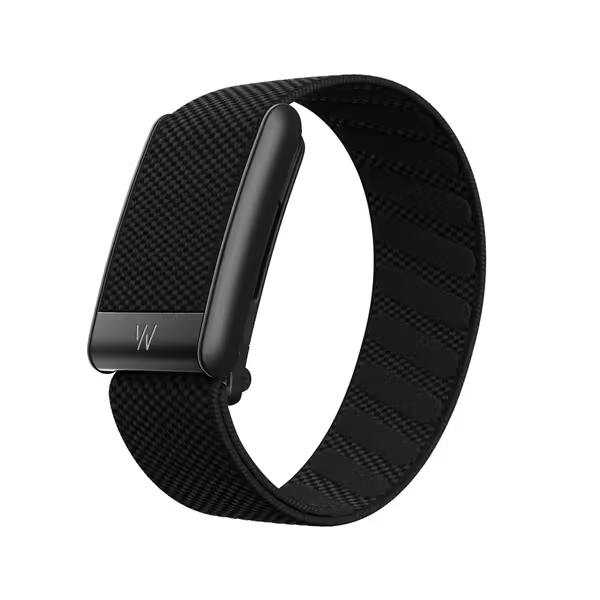
WHOOP 5.0/MG Activity Tracker
24/7 insights for optimized fitness, recovery, and holistic health.
Comprehensive 24/7 monitoring and personalized insights.
Excellent for detailed sleep tracking and recovery.
Very long battery life with convenient wireless charging.
Cons
Mixed feedback on ease of use and certain feature functionality.
Value for money is debated among users.
Customers find the biometric monitor to be of good quality, with detailed sleep tracking and valuable data insights. Moreover, the battery life is amazing, and they appreciate the recommendations for health improvements.
Customers find the biometric monitor to be of good quality, with detailed sleep tracking and valuable data insights. Moreover, the battery life is amazing, and they appreciate the recommendations for health improvements.
Based on recent reviews and the current product description, WHOOP 5.0:
Monitors HR, HRV, sleep, strain, and stress 24/7.
Offers AI-powered coaching that can help you understand how sleep, nutrition, and workouts (including lower-intensity sessions like yoga) affect recovery.
Introduces longevity-focused tools like Healthspan/Pace of Aging and, in some tiers, blood pressure insights.
For yoga and breathwork specifically:
You can log yoga or meditation sessions and see how they impact your recovery and stress markers.
Because it's a strap with more sampling flexibility, many users find HRV and strain estimates robust, especially compared with cheaper devices.
WHOOP's trade-offs for yoga-focused users
It's subscription-only: your upfront purchase includes a membership period, and then you pay to keep advanced metrics and coaching unlocked.
Current reviews note wrist-based HR isn't perfect during certain workouts.
No screen: great for focus, but all feedback is app-based.
From a lifetime cost and data-exit perspective:
WHOOP leans into a membership-first model. Make sure the coaching is worth the recurring spend for you.
Confirm what you can export (e.g., session data, HR, HRV) and how easily, before you build years of history.
For many yoga-first practitioners, WHOOP is overkill. But if yoga is one piece of a performance and recovery strategy, and you're okay with a strap, it can be a strong alternative or companion to a ring.
Renting data is still paying (especially when the business model is explicitly subscription-based).
How should I think about privacy, data exports, and subscriptions for yoga wearables?
This is where most reviews get vague; we won't.
Plain-language privacy decoding
For any ring or strap, look for:
Account deletion: Can you delete your account and all data from within the app without emailing support?
Export options: Can you export your data (ideally in CSV) without a subscription? Is the export complete (HR, HRV, activity, sleep), or just summaries?
Integrations: Does it connect to Apple Health / Google Fit so your data isn't trapped?
Third-party sharing: Is your data used for advertising or shared with "partners"? In what form?
Lifetime cost math for yoga users
When you pick a ring fitness tracker for yoga, include:
Hardware price (ring or strap)
Subscription cost over the years you realistically plan to use it
Battery life and replacement options
Warranty length and what it actually covers
A simple way to compare is to compute an annual cost of ownership: If subscriptions are a deciding factor, compare plans in our fitness tracker subscription guide.
(Device price + total expected subscriptions) ÷ expected years of usable life
Do that for each option you're considering; the "cheaper" device often ends up more expensive once you add three years of subscriptions.
Exit-plan checklist
Before you commit, verify:
You can export all your data today.
You know how to delete your account and data.
You understand what stops working if you cancel a subscription.
If you can't leave with your data intact, think carefully before entering. Own your data, or someone else owns your decisions.
Summary and final verdict: which ring tracker is best for your yoga and breathwork?
Let's tie this together by scenario.
1. Yoga-first, rest-and-recovery focused
Best fit: A mature ring platform like Oura.
Why: Strong sleep and readiness insights, good tagging for yoga and meditation, and solid HRV trends.
Caveat: You're signing up for ongoing subscription costs; build that into your lifetime cost math.
2. Yoga + lifting or running + performance goals
Best fit: A more performance-centric ring like Ultrahuman, or a WHOOP strap if you want maximum strain and recovery coaching.
Why: These tools treat yoga as one component in a broader training load picture.
Caveat: Watch subscription requirements and export tools carefully.
3. Yoga and breathwork with minimal recurring costs
Best fit: A no-subscription ring like RingConn or similar.
Why: You still get HR, HRV, sleep, and stress trends without monthly fees.
Caveat: Apps and algorithms can be less polished; verify export and deletion options.
4. Yoga as part of women's health management
Best fit: A women's-health-focused ring (e.g., cycle- and perimenopause-aware devices like Evie and its peers).
Why: More relevant insights around hormonal shifts, symptoms, and recovery.
Caveat: This is highly sensitive data, so scrutinize privacy terms and exit options.
Bottom line:
Don't buy a ring expecting yoga pose recognition or detailed form coaching; buy it for breathwork, stress, sleep, and long-view recovery.
Treat export, deletion, and subscriptions as core features, not fine print.
Use your ring's metrics to track how you feel over months, not to judge a single class.
If you do that, your ring becomes a quiet witness to your practice instead of another source of pressure or regret, and you'll know exactly what you're paying, in money and data, for the insights you get back.