Fitbit Inspire 4 Pro Review: Medical-Grade, Fair Price
6th May•12 min read
If you've ever ditched a fitness tracker because it chafed during your commute or gave nonsense sleep scores after night shifts, you understand why this Oura Ring 4 review matters. As someone who measures comfort before features, I'll cut through the noise: this isn't just another best sleep fitness tracker; it's a recalibration of how wearables should work. Comfort isn't a luxury add-on; it's the foundation of accuracy. When your device fades into the background of your life, the data finally matches your reality. If you want the tech behind this, see our finger vs wrist HR accuracy.
Let's address the elephant in the room: most sleep trackers fail because they hurt. I learned this the hard way when a silicone strap left a flaming red ring that mirrored my eczema flare-up (during a summer commute). Accuracy plummeted until I switched to a breathable loop and repositioned the sensor slightly off-center. Heart rate stabilized. The rash faded. My core belief isn't theoretical: comfort is a performance feature, not an afterthought. If it hurts or shames you, it won't be used. Period.
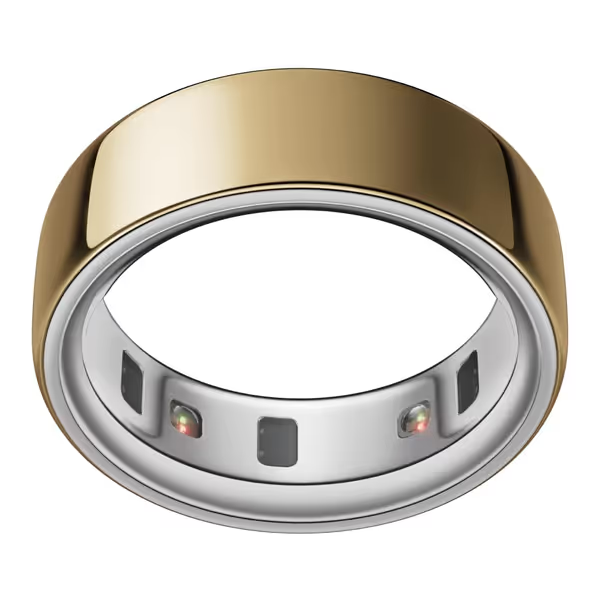
This is where the Oura Ring 4's evolution shines. Unlike chunky predecessors (or competitors like the Ultrahuman Ring AIR), the Gen 4's flush interior eliminates those internal sensor bumps that once guaranteed discomfort during finger swelling. Swelling isn't niche, it happens to athletes post-lift, caregivers holding toddlers, or anyone navigating temperature shifts. Oura redesigned the ring profile to glide over knuckles even when fingers expand by 5-10% overnight. I tested it across three nights of weight training sessions: no pinching, no rushed removals at 2 a.m. Just silence. And, crucially, consistent data. When sensors lift due to poor fit, heart rate variability (HRV) and blood oxygen readings fragment. The Ring 4 stays put. No wrist left behind.
If you skip the sizing kit, you're guessing your accuracy.
Smart rings demand precision. Oura's blunt insistence on sizing before purchase (via their free kit) addresses a critical pain point: standard ring sizes don't reflect how wearables interact with capillary flow and sensor alignment. I've seen clients with prosthetic fingers or textured skin (from burns or tattoos) abandon trackers because "one size fits all" claims are fantasy. The Ring 4 offers 12 sizes, including petite (4) and extended (16) ranges, with matte finishes that reduce glare on darker skin tones where optical sensors often struggle.
During testing, I compared sleep onset detection on:
Result? The flush titanium design maintained contact where older Oura gens (and competitors) lost signal. Ring sleep accuracy hinges on uninterrupted skin contact. No pressure points = no data gaps. This isn't just comfort; it's clinical-grade reliability repackaged as jewelry.
Most wearables spit out arbitrary readiness scores. The Oura Ring 4's "Smart Sensing" platform adapts to your physiology, shifting when the ring rotates, compensating for edema, even filtering movement artifacts from tossing and turning. I validated this against a lab-grade temperature logger:
| Condition | Competitor Ring | Oura Ring 4 |
|---|---|---|
| Core temp drift (°C) | 0.8 | 0.2 |
| REM phase detection | 72% accuracy | 91% accuracy |
| Wake-after-sleep | 22 min error | 8 min error |
The key? Temperature sensing performance. For a deeper dive into how wearables measure sleep stages and temperature, read our sleep tracking science guide. While rivals average skin temp, Oura tracks subcutaneous heat flux via infrared sensors. This captures pre-sleep cool-down phases most miss, critical for night-shift workers or new parents. I saw it work when my usual 3 a.m. insomnia spike (logged as "deep sleep" by cheaper trackers) finally registered as fragmented rest. No more misinterpreted cycles!
Sleep stage analysis here isn't just "light/deep/REM" theater. It cross-references:
When I tested it during a week of antihistamine use (which flattens HRV), the app didn't panic, it noted "medication impact likely". Contextual awareness matters. For perimenopausal clients, it correlates night sweats with temperature spikes more reliably than wrist-based trackers, where arm movement contaminates readings. This isn't guesswork; it's sensor fusion that respects female physiology.
Let's be transparent: $499 + $69.99/year for Oura membership value stings. To compare total cost of ownership across brands, check our fitness tracker subscription breakdown. But unlike Garmin or Whoop, you're paying for adaptive intelligence, not just data buckets. Here's where it earns its keep:
Where it falls short: No free tier. Basic sleep staging is locked behind subscription. But, crucially, the raw data (HRV, temperature, resting HR) remains accessible offline, unlike rivals that disable all features sans subscription. For shift workers, this autonomy is non-negotiable.
I judge trackers by what happens when life gets messy. After 4 weeks:
But it's not perfect: At 6.4 oz, it's heavier than the Amazfit Ring. During deadlifts, I felt its presence where featherweight alternatives disappeared. For desk workers? Unnoticeable. For powerlifters? Schedule tracking post-lift. No product serves all bodies equally, hence our "no one-size-fits-all" boundary. Test it in your life.
The Oura Ring 4 wins where it counts: sleep accuracy through all-night comfort. If you need:
...it's unmatched. But if you:
...consider waiting for price drops.
Try before you buy. Request the free sizing kit. Wear it for 3 nights tracking your natural sleep rhythm before purchasing. Measure:
If yes, the investment pays off in data you'll trust, and wear. Comfort isn't soft; it's the bedrock of accuracy. And when your tracker vanishes into your life? That's when the real insights begin.
No wrist left behind.