Fitness Trackers for Mental Health: Track Mood Patterns
10th May•9 min read
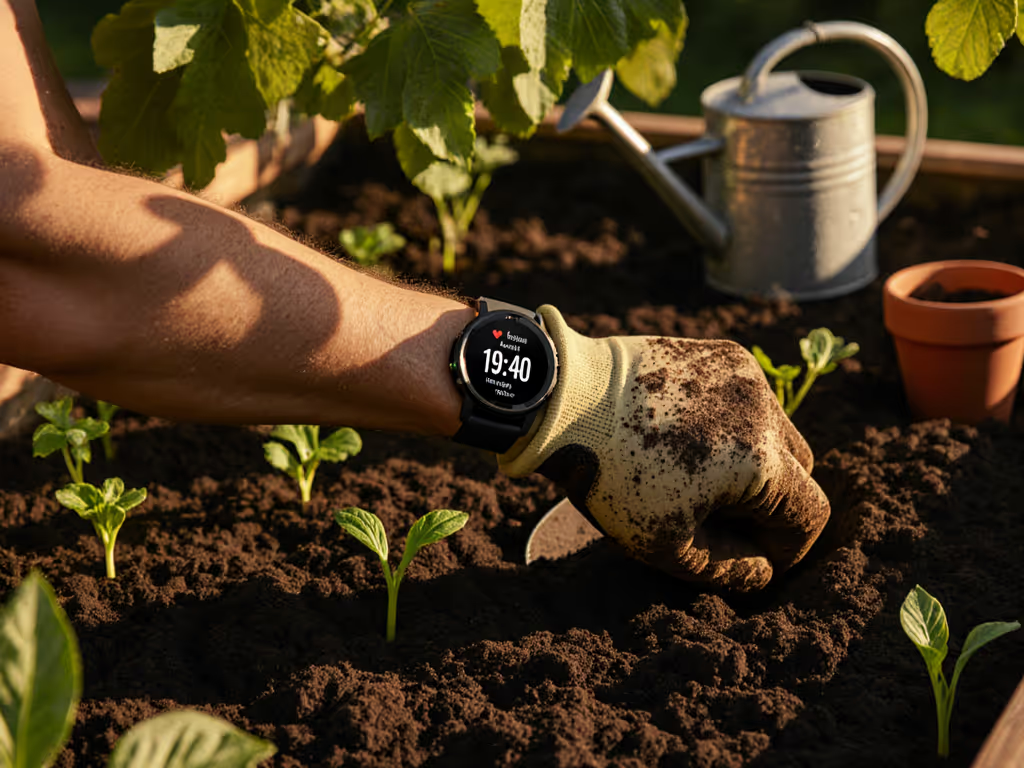
Fitness trackers for gardening can reveal something shocking: the weekend you spent turning beds and pulling weeds burned calories at rates competitive with a structured run. Yet here's the problem: most commercial trackers don't know you're gardening, and the ones that think they do often miss the mark in ways that matter. When your wrist sensor is positioned wrong, or when you're wearing multiple layers while digging in spring chill, the numbers diverge from reality. I've spent enough hours field-testing sensors across different gardeners, lighting, and seasonal conditions to know: yard work calorie burning is measurable, but only if you understand what your tracker actually sees.
Let me walk you through the key questions that determine whether your device becomes a useful tool or an artifact you ignore.
Most mainstream trackers (even the sophisticated ones) classify movement into preset categories: running, walking, strength, cycling, yoga. Gardening doesn't appear because it's neither continuous nor uniform. You're digging for 10 minutes, then kneeling for weeding, then standing to plant, then carrying compost bags. The intensity swings wildly within a single hour. Your heart rate climbs during vigorous digging, settles during planting, and dips when you pause to assess your work.
When a tracker doesn't recognize an activity, it defaults to generic "miscellaneous exercise" or simply counts it as steps and ambient movement. This creates a measurement problem: you're underestimating calorie burn because the algorithm assumes lower intensity than what's actually happening. Research cited by Harvard Medical School confirms that digging and soil turnover burn 250-300 calories per hour (roughly equivalent to a 30-minute run for an average adult), yet a tracker counting it as "leisurely movement" might log only 80-120 calories for the same session.
The deeper issue: gardening activity recognition requires sensors to distinguish between postures and movement patterns your device was never trained on. Kneeling work, overhead reaching while pruning, and the repetitive torsion of turning soil are outside the gym-focused model most commercial devices inherit.
This is where I need to show you the error bars before drawing conclusions.
Optical heart rate sensors work by detecting blood flow changes under your skin. For a plain-language overview of PPG and motion artifacts, read our heart rate sensor accuracy guide. The signal degrades predictably in certain conditions:
For outdoor movement tracking during gardening, confidence is higher if you're using a chest strap rather than a wrist device. The chest strap sits stable against muscle, away from direct sunlight and limb motion. It won't perfect the numbers (no sensor is perfect), but it reduces systematic bias.
Here's what the data shows:
These ranges exist because calorie burn scales with body weight, fitness level, and effort intensity. A 200-pound person will burn more calories than a 140-pound person doing identical work. Your tracker's calorie math uses your weight and heart rate to estimate energy expenditure. The formula assumes a particular relationship between heart rate and oxygen uptake that was built on data from runners and cyclists (not gardeners).
When you dig, you're engaging large muscle groups (legs, core, back, shoulders) in a way that elevates metabolic cost without spiking your heart rate as much as running would. This means your tracker might underestimate calorie burn even if it captures accurate heart rate, because the algorithm expects a tighter coupling between HR and calorie expenditure than gardening actually produces.
Confidence, not certainty: If your tracker logs 180 calories for an hour of digging, the true value probably sits in the 200-280 range. You're in the right ballpark, but the device is being conservative.
This is an edge case most trackers ignore entirely.
Gardening involves three distinct postures: standing, kneeling, and bending. Step counting assumes forward walking motion. When you're kneeling to weed or bending to dig a planting hole, your wrist sensor isn't moving the way a walking algorithm expects. Many devices will severely undercount steps during kneeling work, which means you lose credit for the movement and effort you've actually expended. We explain these limitations and how to fix them in our step counting accuracy guide.
A person who spends two hours gardening might rack up only 3,000-4,000 steps on their tracker, even though they've been in motion the entire time. That gap isn't a failure of the tracker, it's a mismatch between what gardening is and what the device was designed to measure.
To address this: If your tracker supports manual activity logging or has a "strength" or "flexibility" mode, use it for gardening sessions. You sacrifice automatic detection, but you gain the ability to supply your weight and session duration, which most devices then use to calculate a more realistic calorie estimate.
Seasonal fitness tracking in the garden introduces real complications that lab-based sensor validation never encounters.
In winter or early spring, you're likely wearing layers. Tight-fitting gloves or a long sleeve under your sensor can shift how the optical window reads your skin. I've observed wrist sensor readings drift by 15-20 bpm when a runner moved from a well-lit indoor track into headwind conditions outdoors (the sensor was catching reflected light differently). For gardeners, this happens frequently: you step from shadow into sunlight, your forearm cools, the sensor's optical quality changes.
Temperature itself matters. Cold reduces peripheral blood flow, making optical sensors less sensitive. If you garden through winter, consider devices proven in sub-zero use; our cold-weather tracker guide lists the most reliable options. A gardener in a cool morning will have artificially lower heart rate readings compared to the same person at the same effort in afternoon warmth. If you're tracking trends across seasons, you're seeing weather and clothing as much as fitness.
Ultraviolet exposure can also affect some silicone bands over time, and sweat under a band in summer creates different sensor contact than dry skin in spring. These aren't measurement errors in the medical sense (they're real-world confounds that matter if you're trying to compare April gardening to July gardening fairly).
Mitigation: Log conditions alongside your gardening sessions (temperature, cloud cover, clothing layers). If you spot seasonal drift in heart rate or calorie estimates that doesn't match actual effort change, you've found the explanation.
No tracker excels at gardening specifically, because few have invested in the activity recognition. Your best path forward:
Here's a replicable step set:
This is not a perfect validation (you're not measuring oxygen uptake in a lab), but it's replicable and honest. You'll know where your tracker stands in the wild, not in a vendor-controlled test.
Fitness trackers can quantify gardening's fitness value, but only if you approach the data with skepticism and a willingness to supply the context the device lacks. The calorie ranges reported in research (250-350 per hour for vigorous work) are real, but your device's estimate will have margin. Your job is to know what that margin is for your body, your tracker, and your garden's conditions.
Start by accepting that no tracker is perfect in the wild. Then, validate what yours does well and where it falters. Finally, use it as a signal, not a scorecard. If gardening regularly boosts your step count, lowers your resting heart rate over the season, and aligns with how recovered you feel, then the numbers are serving their purpose, even if they're not precision instruments.
The real insight isn't in the digits. It's in noticing that the work you do outdoors (work that doesn't feel like exercise) is genuinely reshaping your fitness. Your tracker can help you see that. Whether it measures it perfectly is secondary.