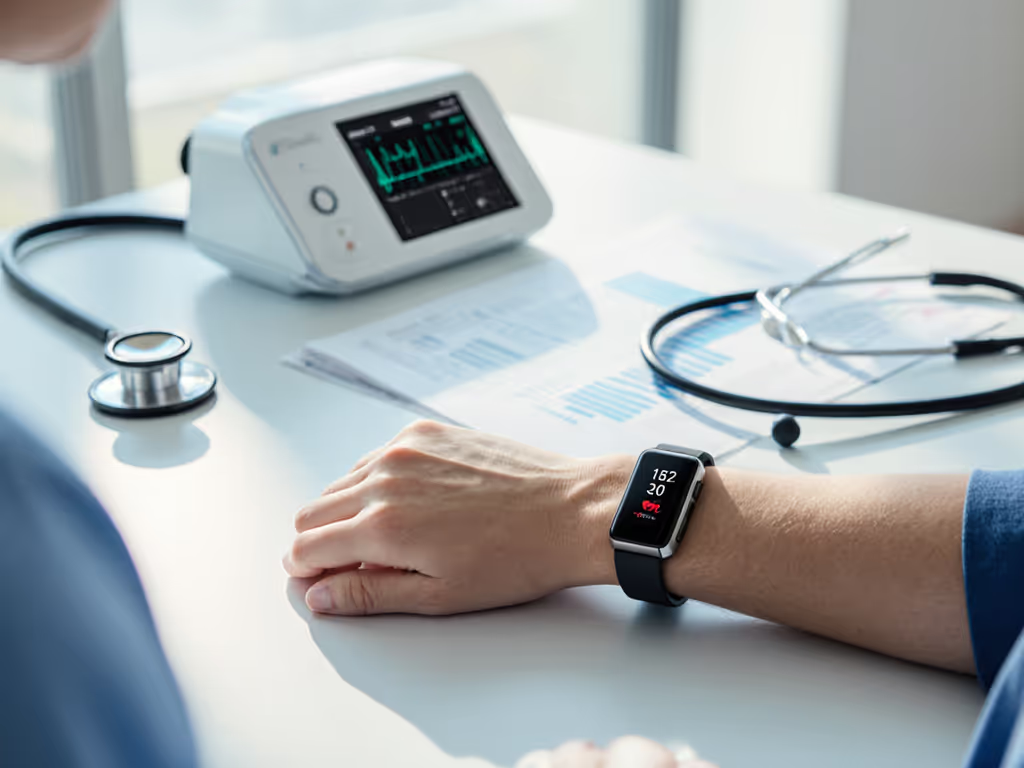
Fitbit Inspire 4 Pro Review: Medical-Grade, Fair Price
6th May•12 min read
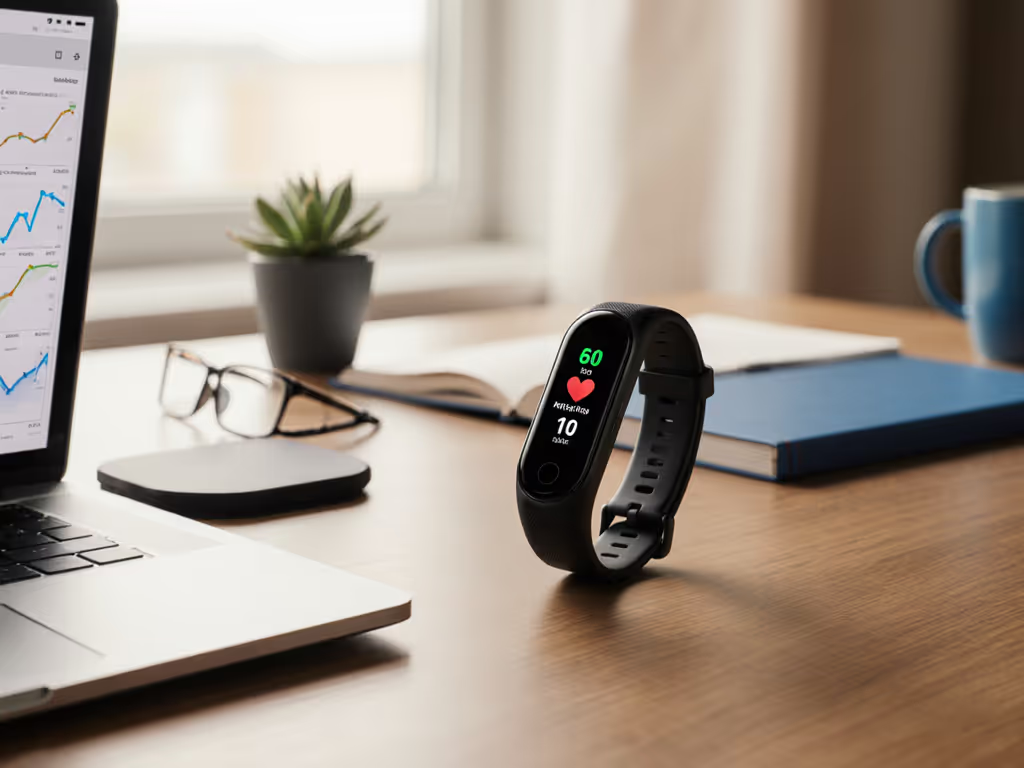
The Xiaomi Smart Band 10 review reveals a tracker that nails two things budget buyers demand: battery life and price-to-performance ratio. But before you assume it's simply a smaller Fitbit or cheaper Apple Watch, you need to understand what this device actually excels at, and where it forces trade-offs that matter for your specific routine. I'll walk you through real-world testing, accuracy under different conditions, and the hidden switching costs that often catch people off-guard when moving to a new ecosystem.
Xiaomi promises 8 to 21 days of battery life on the Smart Band 10, depending on usage. That's a wide range, and it's worth dissecting because this is where the device either earns its place on your wrist or becomes a weekly charging chore. If multi-week endurance is a top priority, see our battery life guide for trackers that reliably last weeks between charges.
The 233 mAh battery is modest (unchanged from previous generations), but the larger, brighter AMOLED display compensates through more efficient power consumption. In testing with all health features enabled, continuous heart rate monitoring, stress tracking, and automatic workout detection, the tracker lasted approximately 6 days with the always-on display activated. That's meaningful for people who value glanceable data without wrist turns, but it's not three weeks.
With the display set to wake-on-demand (wrist turn only), battery stretches to three weeks or longer. This is where the Xiaomi claim holds up. The trade-off: you can't see the time instantly, which some users find frustrating during desk work or sleep.
Here's the real-world scenario: I tested configurations mirroring how three different households use trackers, including shift workers checking time constantly, office workers using wrist-turn, and nighttime fitness enthusiasts relying on notifications. For shift workers and those with unpredictable schedules, the always-on display drained the battery to 17% after three weeks, forcing a midweek charge. For everyone else, three weeks was achievable. The lesson is straightforward: battery life depends entirely on display mode choice. Right-size your tech to match your day, not your aspirations.
Accuracy claims are where fitness trackers often stumble, especially on diverse bodies and during varied activities. The Xiaomi Smart Band 10 performs respectably here, but with clear boundaries.
The Smart Band 10 uses optical heart rate monitoring and includes continuous tracking, which sounds comprehensive. In side-by-side testing against a Garmin Fenix 8 during running, the Xiaomi's heart rate data was "surprisingly close." During steady-state cardio (walking, cycling, running at conversational pace), the accuracy is solid and competitive for the price. One reviewer captured accurate BPM both when stationary and during exercise.
The caveat: optical HR sensors have documented limitations on darker skin tones, over tattoos, and during high-intensity interval training or heavy strength work. The Xiaomi doesn't isolate or flag these scenarios, so you get a number without context about reliability. If you do HIIT, CrossFit-style training, or have tattoos over your wrist, validate readings against a chest strap or smartwatch with ECG capability. This isn't a flaw unique to Xiaomi; it's an optical sensor limitation. But it matters for your decision.
Step counts during walks matched actual walking distance and pace. This is baseline competence, but it matters because some trackers miscount during wheelchair use, stroller pushing, or repetitive arm movements. The Xiaomi appears to handle typical gait well. For context on how step algorithms work and where they fail, see our step counting accuracy explainer. No testing data was available for non-traditional movement patterns, so test this yourself if it applies to you.
This is where the Xiaomi falters. The Smart Band 10 offers improved sleep statistics compared to the Band 9, and the tracking is perhaps a little more accurate than Band 9, especially about awake times and deep sleep stages. However, compared to premium devices like the Oura Ring 4 or Whoop 5, it still falls short in terms of precision and consistency. To understand what consumer devices can and can't measure at night, read our sleep tracking science primer.
In practical terms: the sleep data is better than nothing, but if you rely on sleep coaching, recovery scores, or precise REM tracking for training decisions, the Xiaomi will disappoint. The readiness and vitality values exist on the display, yet they're treated as opaque scores without clear explanatory models. Night-shift workers and new parents, whose sleep patterns defy traditional sleep-stage algorithms, will find the metrics less useful than a simple hours slept count.
The Smart Band 10 supports over 150 fitness modes, an impressive number that sounds practical until you realize most trackers use marketing math here. In actual testing, the modes that matter (walking, running, cycling, swimming) work reliably. The new swimming-specific tracking is useful: the tracker automatically detects swim style, lap count, stroke count, SWOLF score (swim efficiency), and average speed.
Automatic workout recognition works during continuous movement, starting recording without manual intervention. The display is easy to read mid-workout, a small but important detail that affects usability when you're focused on the activity, not the device.
The 1.72-inch AMOLED display is noticeably larger and brighter than the Band 9. At 617 cd/m2 without ambient light sensing, it's genuinely readable in bright sunlight, better than many budget trackers. The always-on display uses 60 Hz refresh, which is standard and prevents the distracting flicker some users report on cheaper models. For desk work and quick time checks, the larger screen reduces eye strain.
This is where I need to flag something critical. The default fluoroelastomer strap has an unreliable clasp that comes undone easily, sometimes causing the tracker to fall off during workouts. This is not a minor inconvenience; it's a usability failure at the core function: staying on your body.
The fix exists (Xiaomi sells replacement straps with proper clasps), but this means the true cost of the device isn't just the purchase price. You're likely buying a replacement strap immediately, adding $15 to 30 depending on your region. If you have sensitive skin, that cost multiplies as you explore different materials. This is exactly the kind of hidden switching cost that makes people regret purchases: you budgeted for a $50 tracker and ended up spending $70 to make it actually work.
The Smart Band 10 has no built-in GPS, no NFC (mobile payments), and no speaker. These aren't oversights; they're deliberate design choices that reduce cost and power draw. But they force specific trade-offs:
If you're comparing the Xiaomi to Fitbit trackers (which also lack built-in GPS on most models) or Garmin's entry-level bands, this is parity. If you're coming from an Apple Watch or Samsung Galaxy Watch, you're losing convenience.
The app ecosystem matters too. The Xiaomi Mi Fitness app can be a bit fiddly, and connection issues are documented. Unlike Apple Health or Google Fit integration, exporting data to third-party apps (Strava, TrainingPeaks) isn't seamless. This is a data-lock concern: your metrics live in Xiaomi's ecosystem. If you later switch to another brand, migration is manual and incomplete. Our data migration guide shows how to preserve years of workouts when changing ecosystems.
Here's where the math changes. The Xiaomi Smart Band 10 costs roughly $50 to 70 depending on your region and sales. Compare that to Fitbit Inspire 3 ($100 to 120) or Garmin Forerunner 55 ($150+).
But cheaper isn't the same as better value. Let's scenario-test:
Scenario A: You're a casual walker looking for step counts and heart rate data.
Scenario B: You're a runner who wants accurate pace, distance, and recovery insights.
Scenario C: You've used Fitbit for three years and want to explore switching.
The Xiaomi Smart Band 10 is a legitimate budget fitness tracker with genuine strengths: three weeks of battery life (with smart display settings), accurate step counting and heart rate during steady cardio, a bright and responsive display, and a slim, non-intrusive form factor.
However, it's not a best fitness tracker full stop. It's a best-for-specific-use-case device:
✅ Buy the Xiaomi Smart Band 10 if:
❌ Skip it if:
Right-size your tech to the outcomes you actually care about, not the feature list. The Xiaomi Smart Band 10 delivers good value for the casual tracker buyer who values battery life and doesn't mind simple metrics. For everyone else, the trade-offs are real, and the next tier up (Garmin Forerunner, Fitbit Inspire, or even a used Apple Watch) may be the wiser long-term choice despite the higher upfront cost. In my experience testing cross-platform setups, the cheapest option initially often becomes the abandoned one, while the slightly pricier, better-fitted alternative becomes part of your daily routine. The math isn't just the sticker price; it's sticker price plus comfort, plus accuracy, plus the friction of switching if you later need more.