
Sustainable Wearables: Smart Rings Beat Fitness Tracker E-Waste
4th Nov•5 min read
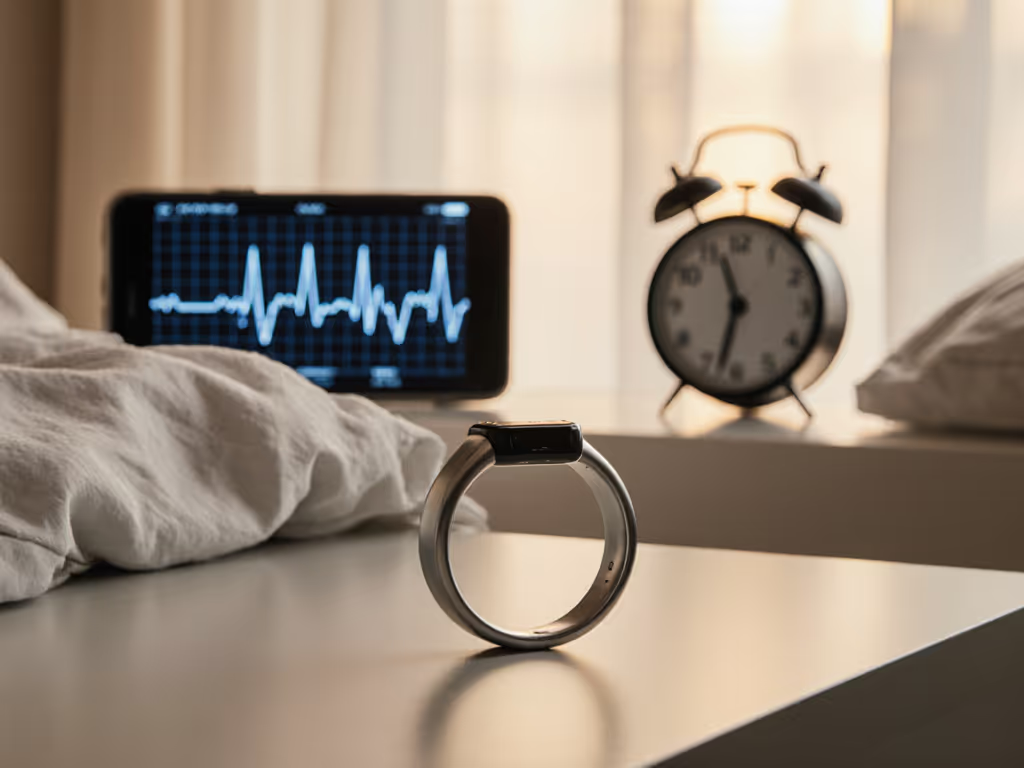
You've scrolled past countless claims: a fitness ring tracker that detects arrhythmias, monitors your heart like a clinical-grade device, warns you of irregular rhythms before your doctor does. Then you put one on, and within hours the app flags something that doesn't feel real, or the numbers don't match what you felt during your workout. Welcome to the gap between marketing and meter, and to the surprisingly human reasons why ECG accuracy in wearables varies so wildly, even among rings bearing clinical badges.
The truth is simpler and messier than you've been told. ECG accuracy depends less on whether the ring has the sensor and more on whether the ring actually stays put on your body.
You're not wrong to be skeptical. Smart rings (especially those claiming ECG capabilities) promise precision that sounds like overkill for a device smaller than a vitamin. Yet the industry keeps reminding you of their advantages: they sit on your finger, not your wrist; they avoid the skin sensitivity traps of bands and straps; they're supposed to be continuous, invisible, unfussy.
But then something shifts. Your ring drifts slightly off-center. You grip a weight or brush your hand through cold water. You sleep on that hand. Suddenly, the readings don't make sense, or they do, but they contradict what your body tells you. The app sends an alert about irregular heart rate, and you spend three hours in panic mode before realizing the data was an artifact.
The deeper frustration: you don't know whether the ring is failing, the sensor is failing, or your data collection method (the fit, the wear angle, the materials touching your skin) is sabotaging accuracy from the start.
When a ring claims to measure ECG accuracy or AFib detection reliability, here's what it's actually trying to do: use optical sensors (or less commonly, electrical sensors) to detect the electrical activity of your heartbeat.[2] Most rings use PPG (photoplethysmography), which emits light into your skin and measures how blood volume changes with each pulse. Some advanced rings also add ECG capability, which detects the electrical signal directly.[6]
The science is solid in the lab. A clinical research study found that smart rings showed exceptional performance for arrhythmia detection in a controlled setting, with 94% overall sensitivity, and near-perfect correlation (r² = 0.996) with hospital-grade ECG for nocturnal heart rate.[3] During sleep, when your body is still and contact is consistent, rings deliver clinical-level accuracy.[1]
Then you wake up.
Here's what the research confirms but the marketing doesn't emphasize: accuracy plummets the moment your hand moves.[5] A ring has a much smaller contact area than a smartwatch. A slight shift (your finger swelling as you exercise, the ring rotating even a few millimeters, your hands cooling during a morning run) breaks the optical signal. When you're gripping weights, moving your hands during HIIT, or even typing intensely, the readings become unreliable.[5]
Darker skin tones, tattoos, and scars also scatter light differently, making optical sensors less reliable on these bodies, a well-documented bias in wearable validation.[3] For deeper testing across diverse skin tones, see our skin tone accuracy validation. The ring doesn't fail because of a flaw in the technology; it fails because the assumptions about consistent skin contact and light absorption don't hold universally.
Add in cold hands, and the blood flow to your fingers drops, worsening signal quality.[5] Move into bright sunlight, and ambient light interferes with the sensor's ability to distinguish your heartbeat from noise.
A cardiologist quoted in recent coverage put it plainly: rings can't detect arrhythmias as accurately as an ECG, and they certainly can't predict a heart attack. False alarms from wearables have caused real panic in patients, while false reassurance has caused others to ignore genuine symptoms.[5]
This is where my own experience intersects with the data. Years ago, I tested a silicone strap on a ring (sleek, comfortable at first). By mid-summer during my commute, it left a red ring that matched my eczema pattern. The sensor's accuracy degraded as my skin inflamed, but I didn't connect the two. I switched to a soft, breathable fabric loop and adjusted the ring slightly off-center to sit where my skin felt best. Heart-rate readings improved noticeably, and the rash faded. Comfort wasn't a luxury, and accuracy followed it.
That moment crystallized something: if it hurts or shames you, it won't be used, and if it's not used properly, the data is worthless.[5] Tight rings limit blood flow. Materials that trap moisture breed bacteria and irritation. A ring that slides on and off during wear collects motion artifacts instead of heartbeats.
Yet almost no manufacturer guidance addresses this. Instead, they publish sensitivity figures and clinical studies, omitting the pedestrian reality: the best sensor in the world is useless if the ring doesn't fit your hand, your skin, your rhythm of living.
Rings shine during clinical validation of wearables in one specific zone: sleep. Because your body is stationary, contact is stable, and there are no competing movements, rings deliver hospital-grade accuracy for heart rate and heart-rate variability at night.[1][3] Learn how wearables actually measure sleep in our sleep tracking science explainer. If you want reliable sleep-based insights (recovery markers, sleep quality relative to daytime stress), a ring is genuinely useful.
Some advanced rings, calibrated with a blood pressure cuff, can estimate blood pressure with reasonable accuracy (±3% for oxygen saturation, ±2 bpm for heart rate when calibrated).[6] This is worth noting for condition management, though it's not a substitute for clinical measurement.
During and immediately after exercise, don't trust the ring's heart-rate data for precision. If you're tracking training zones or interval intensity, a chest strap or wrist-worn watch with motion-resistant sensors will outperform a ring.[5] To pick the best sensor type for each workout, read our chest strap vs wrist vs ring comparison. The smaller contact area and movement profile of your finger mean the ring is fighting physics.
For AFib detection, rings show promise in research but inconsistency in real-world use. If AFib detection is your priority, start with our AFib detection reality check to understand what's validated and what's not. Some ECG-capable rings exist, but even they are best used as a complementary monitor, not a diagnostic tool. If your app flags arrhythmias, contact your doctor, and don't assume it's definitive.[5]
If you have darker skin, tattoos, or significant scarring, validate the ring's readings against a medical-grade device or a wrist-worn tracker in your first two weeks. Optical sensors vary in their ability to read your particular skin, and you deserve to know whether the numbers reflect your physiology or a sensor limitation.
This is the insight manufacturers rarely articulate: comfort is a performance feature. A ring that fits your hand, uses breathable materials, and sits at an angle that works for your body geometry will collect better data than a precisely engineered sensor in a poorly fitting package.
Take time to find the right size (not the median size, your size). If a ring comes with multiple strap materials, test the breathable loop before the silicone. If your skin reacts, switch immediately; inflammation and irritation compromise both your well-being and your data fidelity. Adjust wear position if needed; the optimal spot for the sensor isn't always the middle of your ring finger.
If it hurts or feels restrictive, the ring will slide, rotate, or be removed, and then the data stops meaning anything.
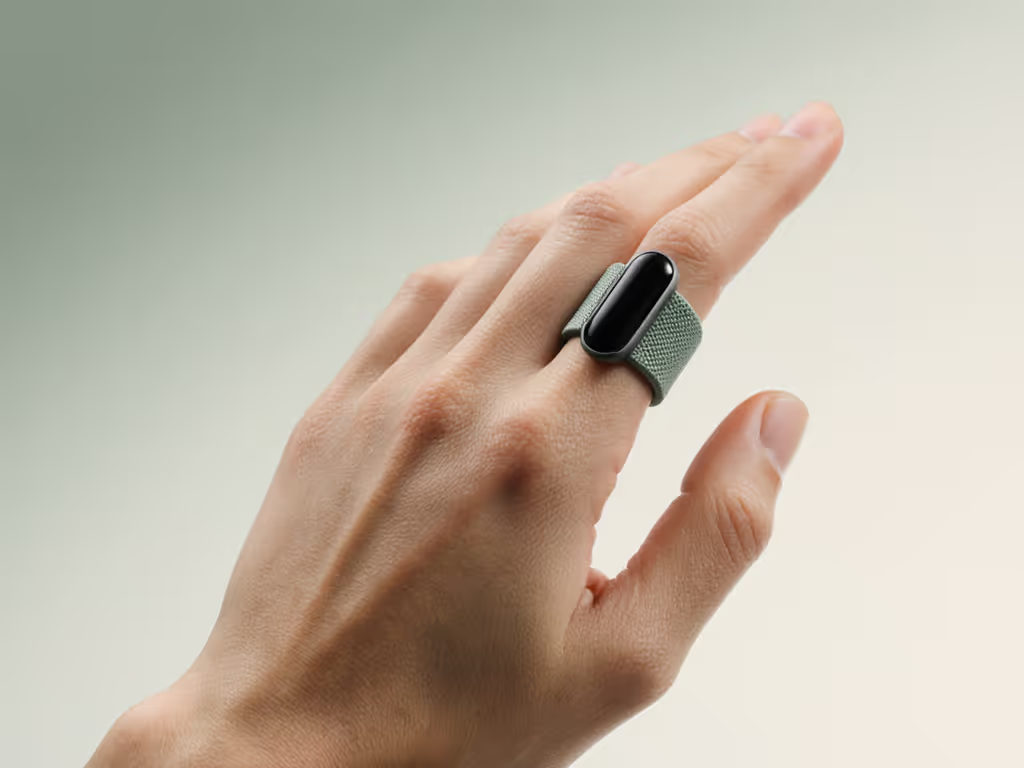
A fitness ring tracker with ECG capability is a legitimate health device in the right context. It excels at continuous sleep monitoring, recovery tracking, and detecting patterns over time. It's genuinely useful for that subset of people who want unobtrusive, all-day data collection and can tolerate its limitations.
But it's not a clinical diagnostic device, and framing it as such (or purchasing one under that assumption) sets you up for false confidence or false alarm.
The ring's real power isn't in replacing your doctor's ECG; it's in giving you permission to pay attention to your own body's rhythms without the burden of a chest strap or the constant phone notifications of a smartwatch. If that permission comes with honest limits, and if the device actually fits your hand and your skin, then the technology delivers.
If you're considering a ring with ECG or advanced heart rate monitor features:
Clarify the use case. Do you want sleep and recovery tracking (rings excel here), or are you hoping to catch arrhythmias or train by zone? Match the tool to the actual need.
Test fit rigorously before committing. Order the smallest and largest sizes available if possible. Wear each for at least a few days, including a workout, a night's sleep, and a cold-water exposure. Does it slide? Does your skin react? Is it comfortable enough to wear for 24 hours without thinking about it?
Validate data against a reference. In week one or two, wear your ring alongside a chest strap or clinical device (or visit a clinic) during activity and sleep. Compare the readings. This tells you whether your ring, your skin, and your wear pattern yield trustworthy data.
Expect and plan for discomfort limits. If your ring reads poorly during intense exercise or in certain conditions (cold hands, post-tattoo, high sweat), don't panic. Accept the limitation and use a secondary tool for those moments. Rings aren't one-size-fits-all; no wrist (or finger) is left behind if you choose the right tool for the job.
Prioritize comfort materials and fit customization. If the ring offers breathable straps, skin-safe metals, and adjustable sizing, invest in those options. They're not luxuries; they're prerequisites for reliable, continuous data.
The most accurate health tracker is the one you'll actually wear. No wrist left behind means no finger left out of the conversation about what works for real bodies, real lives, and real comfort. Choose the ring that meets you there, and if it doesn't, move on to the next one.