How Sleep Tracking Works And What Your Stages Really Mean
17th Sep•9 min read
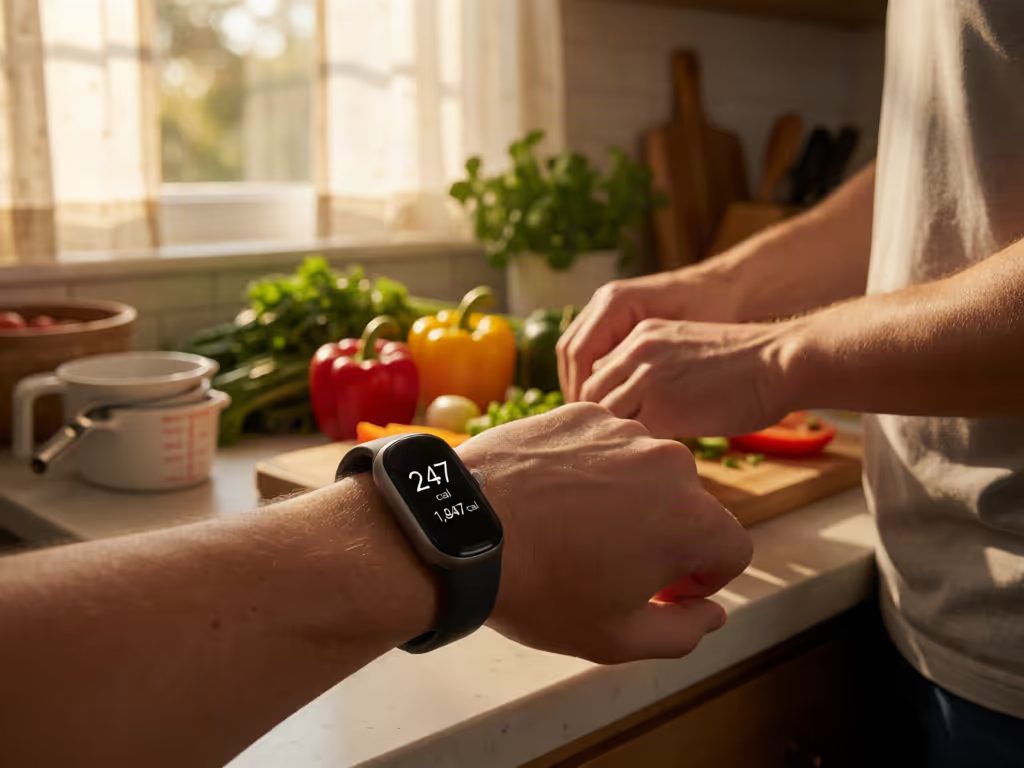
Fitness trackers estimate calorie burn rather than measure it, and the estimates can be substantially wrong. Use them for broad activity context—not as exact measurements or precise food allowances.
Important: The Stanford results apply to devices tested in 2017 and do not establish a universal error rate for current trackers. Heart-rate accuracy also does not guarantee calorie accuracy.
Fitness tracker calorie accuracy is much weaker than the clean number on your wrist suggests. To understand how fitness trackers calculate calories, start with the uncomfortable truth: a tracker does not directly measure the energy your body uses. It produces an estimate from signals and assumptions. That can still be useful, but only if you treat it as a rough instrument for context, not a receipt for food or proof that a workout "counted."
A calorie display looks personal because it has your profile and sits on your body. That does not make it a measurement of your metabolism. The difference matters for anyone trying to avoid false precision, shamey daily targets, or a cycle of eating according to an app that cannot explain its number.
The clearest independent warning comes from a 2017 Stanford evaluation of seven wrist-worn devices. Sixty volunteers wore them while walking or running on treadmills and cycling on a stationary bike. Researchers compared the devices' energy-expenditure readings with metabolic-rate estimates derived from oxygen and carbon dioxide in breath.
The comparison split in two:
| What the devices estimated | Result in that study |
|---|---|
| Heart rate | Six of seven devices had an error rate below 5% under the study protocol. |
| Energy expenditure (calories) | None measured it accurately. The best device was off by an average of 27%; the worst, by 93%. |
Those figures are not a current-market scorecard. They apply to seven devices tested in 2017, in those controlled activities. They do, however, expose a lasting category problem: a reasonably good heart-rate reading does not automatically produce a reliable wearable energy expenditure estimate.
A tracker's calorie total is an output of a model, not a direct reading from your body.
That distinction is where sensible use begins.
Trackers can detect or collect some inputs. The calorie figure is what their proprietary software does with them.
A commercial sports-watch explainer from Hyve describes a typical mix: age, sex, height, weight, heart rate, activity type and duration, plus, on some models, inputs such as motion data, GPS, VO2 max, or heart-rate variability. Inputs and algorithms differ by device.
Here is the ledger-style breakdown:
| Layer | What it means | Where uncertainty enters |
|---|---|---|
| Profile data | Basic user data such as age, height, weight, and sex that Hyve says sports-watch models may combine with other inputs | An algorithm's assumptions may not fit one person well. |
| Observed signals | Heart rate, motion, activity duration, and sometimes location or route data | More inputs do not eliminate uncertainty in the final model. |
| Algorithm | Proprietary calculations that indirectly estimate energy expenditure from inputs | The assumptions may not fit an individual well. |
| Displayed result | In Hyve's terminology, active or total calories | Terminology may not be identical across brands or apps. |
Stanford's researchers described the problem plainly: heart rate is measured directly, while energy expenditure is calculated indirectly through proxy calculations and proprietary algorithms. They also noted that factors including fitness level, height, and weight affect energy expenditure, so an algorithm's assumptions may not fit an individual.
That is why two people can complete the same session and receive different estimates, and why either estimate can still miss the mark.
The most common confusion is not an algorithm failure. It is a label failure.
In Hyve's terminology, total calories are all-day energy expenditure, including basal metabolism and activity. Active calories are energy expenditure beyond normal life. Other apps may use their own wording or calculation boundaries, so check the definitions in your specific app before comparing one number with another.
The practical reading is simple:
In Hyve's terminology, total and active calories refer to different portions of energy expenditure. Confusing them can make a perfectly ordinary dashboard look contradictory.
An estimate can be directionally interesting without being safe to spend, calorie for calorie.
Stanford's researchers specifically cautioned that basing the amount of food eaten on a device's calorie-burn output is a bad idea. That is the right boundary. If the burn estimate is materially wrong, treating it as a precise food allowance creates a false balance sheet: the app appears to settle an account it cannot actually see.
This is not an argument for ignoring your tracker or for turning exercise into a morality test. Wrist-worn wearable feedback has been associated with increased physical activity in an umbrella review of systematic reviews. But that research concerns interventions that include wearable feedback, often alongside other behavior-change components; it does not prove that the calorie figures themselves are accurate.
Use the device for habit-building prompts and routines, and evidence that you moved, not as a nutritional authority.
Hyve recommends focusing on long-term trends rather than one specific calorie number. That is practical publisher advice, not proof that every tracker gives validated personal trends. Still, it offers a better posture than chasing precision from a single workout.
Try this comparison framework instead:
If you wear the same tracker in a similar way and log the same kind of routine, the number can help you notice broad changes in your own recorded activity. Say "my tracker estimated more activity this week," not "I burned exactly this many more calories."
A low display is not evidence of laziness; a high display is not a license, achievement badge, or diagnosis. The estimate is shaped by a model's assumptions as much as by what you did.
Record the activity type, duration, and how the session felt if you are reviewing your habits later. A bare calorie total is thin evidence. Context makes the data more interpretable, and less likely to become a misleading scoreboard.
A dashboard is more valuable when you can keep a usable history and maintain control of your data. I learned that lesson after a "free" app changed its terms and two years of sleep-stage history became a subscription hostage. Calories are not the only metric that can get trapped behind a changing policy. Own your exit: know what you can export, what remains available without payment, and how deletion works before building a long-term personal record.
Own your data, or someone else owns your decisions.
Verywell Health reports that 10,000 steps burns about 500 calories on average. For a closer look at why step counts can vary, see our real-world step-counting accuracy analysis. The important word is "average." Walking speed and body weight matter, and the publisher also identifies age, fitness level, height, intensity, step type, and weight among factors associated with steps and calories burned.
So 10,000 steps is not a universal 500-calorie transaction. Neither is 6,000 steps automatically 300 calories. You cannot safely scale an average into a personal guarantee just because the arithmetic is tidy.
The same applies to ambitious daily-burn targets. A step count alone cannot establish whether a particular calorie total is feasible, appropriate, or healthy for you.
Not accurate enough to treat as an exact measurement. In the 2017 Stanford test of seven wrist devices during treadmill walking/running and stationary cycling, no device measured energy expenditure accurately; average error ranged from 27% for the best-performing device to 93% for the least accurate. That is a study-specific finding, not a universal rating for every tracker sold today.
No. Heart rate is one input, not a direct measurement of energy expenditure. In the Stanford evaluation, heart-rate estimates performed far better than calorie estimates, which is precisely why a plausible pulse reading should not be mistaken for a validated calorie total.
It is an approximation reported as an average, not a promise. Pace, body weight, and other individual factors change the result. Treat a steps-to-calories conversion as rough context rather than a number to eat back or a target you must hit.
For the next two weeks, read your tracker's calorie figure as an "indirectly calculated energy-expenditure estimate," not an exact measurement. Before acting on it, check whether you are viewing active or total calories, keep notes on the routine behind the number, and resist converting the display into a food allowance.
That small language change restores the right hierarchy: your body first, the estimate second. It is the cleanest way to get value from a tracker without handing it authority it has not earned.